The Overwhelmed Professional
You're good at your job — but by noon, you've already reacted to a dozen things that weren't on your plan. You're tired of feeling behind before the day even starts.
You react to everything — emails, pings, demands. The Path gives you 5 simple tools to stop the spiral and lead your day with intention, not impulse.
Instant access · One-time payment
Before
Today · 3 priorities
After
Available on Whop · Trusted by professionals in tech, marketing, and management
Watch how it works · 3 minutes
A quick 3-minute walkthrough of the Reactivity Cascade and the five tools that stop it.
The problem
You've tried the planners. The apps. The color-coded calendars. You've blocked your time, set your intentions, and started Monday with a clean slate.
Then one email arrived. One Slack ping. One "quick question" from a colleague.
And the whole day collapsed.
Here's what nobody tells you: the problem was never your system. The problem is that your nervous system is already running on reserve before you even open your laptop. When your body is in a state of high alert, no planner on earth can help you focus.
You're not disorganized. You're overstimulated. And that's a completely different problem.
The planners, the apps, the productivity books — they were all built to organize your tasks. None of them were built to calm a nervous system that's been on fire for months. So they didn't fail because you weren't disciplined enough. They failed because they were the wrong tool for the actual job. You were trying to fix a wiring problem with a to-do list.
That's not a character flaw. It's not laziness. It's what happens when you've been living in constant reaction mode for so long that it starts to feel like your personality. You snap at your kids and feel guilty. You zone out mid-conversation with your partner. You end the day exhausted — not from doing too much, but from being on alert all day. The body keeps the score, and right now, it's losing.
The opportunity
Most solutions ask you to build better habits when you have energy. The Path was built for the moments when you have none.
It doesn't ask you to overhaul your life or follow a 90-day program. It gives you 5 targeted tools — one for each specific breaking point in your day. The moment you feel the spiral starting, you open the right tool and interrupt it. That's it. No complex system to learn. No willpower required. Just a clear, practical step you can take right now, in the middle of the chaos.
What makes it different is where it starts. Not with your calendar. Not with your inbox. With your body. Because before you can lead your day, you have to stop being run by your nervous system. The Path teaches you to catch the early signals — the tension in your chest, the shallow breathing, the creeping irritability — before they turn into a full reactive spiral. That gap between the trigger and your reaction? That's where your control lives.
Imagine ending a hard day and actually feeling done. Not just physically off the clock, but mentally quiet. Sitting with your family and being present — not replaying the day in your head, not dreading tomorrow. That's not a fantasy. It's what happens when you stop managing the chaos from inside it, and start leading from a place of calm. Two to four weeks in, people start noticing the signals earlier. The days stop slipping. The reactions slow down. And for the first time in a long time, the day starts to feel like theirs again.
Who this is for
You're good at your job — but by noon, you've already reacted to a dozen things that weren't on your plan. You're tired of feeling behind before the day even starts.
You carry a lot of responsibility and even more mental load. You need a system that works when your energy is already gone, not one that requires more of it.
You show up physically, but your mind is still at work. You want to end the day with enough left in the tank to actually be there for the people who matter most.
What changes
Most people notice they're overwhelmed only after they've already snapped, shut down, or lost an hour to nothing. The Path gives you a 12-minute intervention to spot the first signal — before the cascade starts.
A list of 15 tasks doesn't help a drained brain. It paralyzes it. With The Path, your day is built around 3 clear priorities — so you always know what actually matters, even when everything feels urgent.
Hunger, fatigue, tension, overload — your body sends signals all day. Most people ignore them until they explode. The Path teaches you to read those signals early, so they guide your next move instead of derailing your whole afternoon.
The gap between a trigger and your response is where your control lives. The Path trains you to widen that gap, so you stop reacting reflexively and start choosing your next move — even under pressure. This is the core shift: from being pushed by the day to leading it.
Origin
For most of my career, I was the person who kept things moving.
I led construction projects across Poland, Sweden, and Germany. I managed teams, timelines, and pressure that didn't stop on weekends. On paper, I was performing. Inside, I was running on reserve — constantly reacting, constantly behind, constantly waiting for the moment I'd finally feel in control.
I tried the usual fixes. Better planners. Stricter schedules. Morning routines I'd abandon by Wednesday. I read the books. I downloaded the apps. None of it touched the real problem, because none of it was designed for someone whose nervous system was already in the red. Those tools assume you have calm, focused energy to implement them. I didn't. Most days, I had nothing left.
The real breaking point wasn't dramatic. It was quiet. It was ending another day feeling like nothing I did was actually mine — like the day had just happened to me. Emails, messages, urgent requests. I reacted to all of it. I chose none of it. And I noticed the same pattern in the people around me: smart, capable professionals running on autopilot, burning out slowly, convinced the problem was their discipline.
It wasn't discipline. It was the wrong tool for the wrong problem.
So I stopped trying to organize the chaos and started working on what was actually causing it.
Over two years, I pulled from psychology, philosophy, and hard-won field experience to build something different. Not a planner. Not a productivity hack. A system built specifically for the moment when you have no energy left to decide — five tools, each one designed for a specific breaking point in the day. I tested it on myself first. Then I watched others use it. The shift wasn't instant, but it was real: within two to four weeks, people started catching the first signal of overload before it took over. They started ending days with something left in the tank.
That system is The Path.
It exists because I needed it and couldn't find it anywhere else.
More about me: ekune.com
Proof of methodology
You're early. No public testimonials yet. So instead of fake quotes, here are the three frameworks built into The Path.
Mechanism
The named mechanism for why your day falls apart: chronic overstimulation erodes your capacity for choice, each trigger primes you for the next, and the cycle feeds itself.
Counter-mechanism
Create a gap between stimulus and response, shift from sympathetic reactivity to prefrontal control, regain the power to choose.
Signal map
A somatic signal map. In Stage 1 (Checklist) and Stage 4 (Tracker), you learn to recognize the four early signals of overload — hunger, thirst, fatigue, overstimulation — before they run you over.
These aren't motivational concepts. They're operational tools, each one designed for a specific moment in your day.
How it works
You get the Calm Recovery Checklist. A 12-minute intervention. It helps you spot the first signs of overload before your day spirals. Most people miss this window. You won't.
The Calm Recovery Planner uses a 3-criteria method to create a gap between the trigger and your response. That gap is where your control lives. You stop reacting. You start deciding.
Taming Your Day gives you fixed windows for email, messages, and media. No more constant pinging pulling you off course. You decide when information gets your attention, not the other way around.
The Body Signals and Overload Tracker maps your 4 horses: hunger, thirst, fatigue, overstimulation. You learn to read these signals early. Before they run you over.
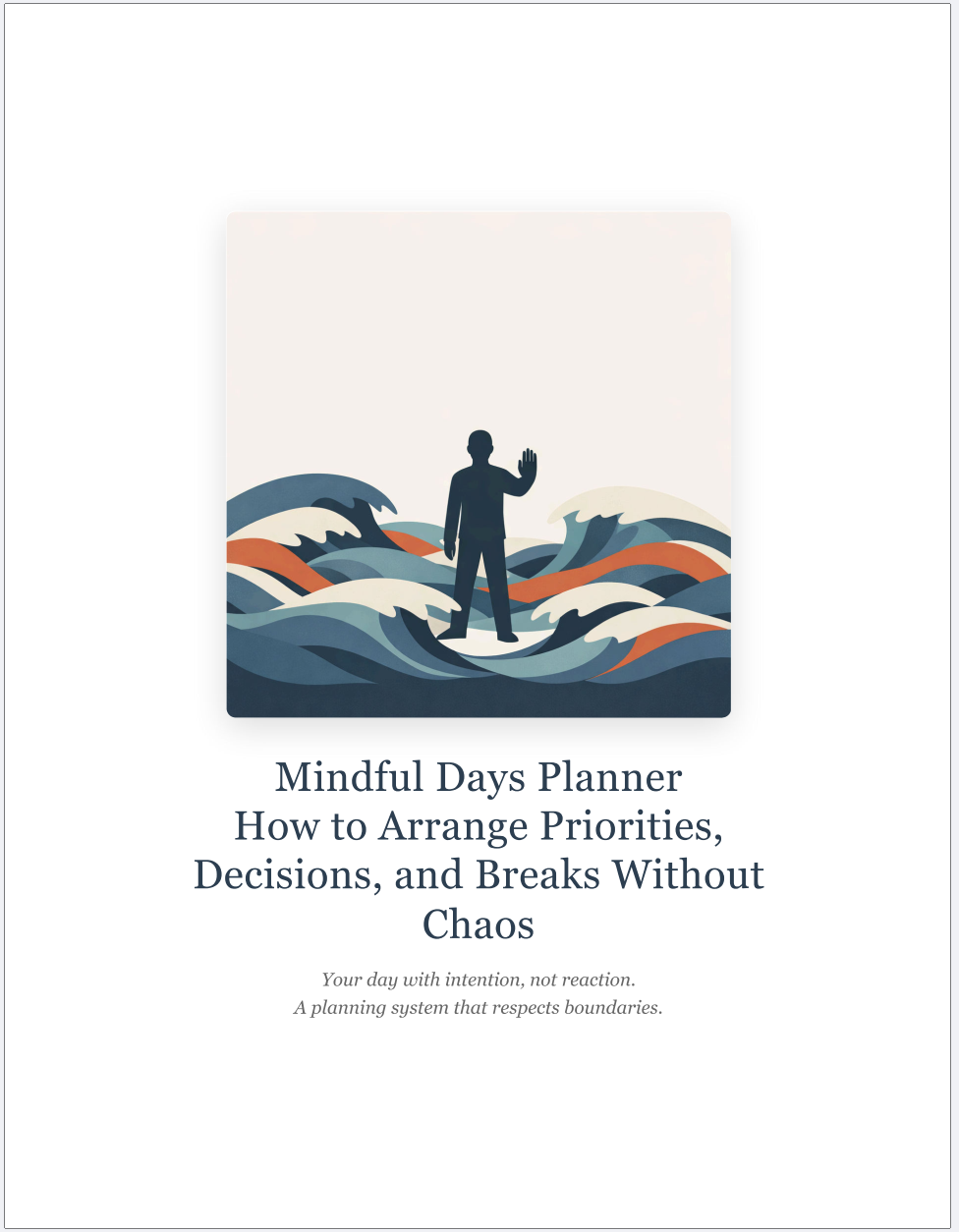
The Mindful Days Planner is your daily blueprint. 3 priorities. Scheduled breaks. Buffers. An evening review. You end the day with silence in your head, not noise.
The investment
One-time payment
Instant access after purchase. No subscription. No hidden fees.
Our guarantee
Use The Path for 30 days. Apply the tools in your real days. If you don't feel more in control of your day — or less reactive — or if you're not satisfied for any reason, email us for a 100% refund.
No questions. No forms. No awkward conversations.
You keep the entire toolkit as our gift. The 30 days are yours to test, learn, and decide.
Future vision
It's 6:47 PM. You close your laptop. The day didn't go exactly to plan — there were two urgent interruptions and a meeting that ran over. But you caught both. You didn't snap. You didn't spiral. You noticed the first signal before it took over, used the right tool, and kept going.
At dinner, you're actually there. Your partner mentions something funny that happened at work, and you laugh — not because you're supposed to, but because you heard it. Your kid tells you about a game they invented, and you ask a follow-up question. You remember the question you said you'd ask.
After they go to bed, you sit for 10 minutes. Not scrolling, not catching up. Just sitting. The house is quiet. Your head is quiet. Tomorrow you'll wake up and do it again — imperfectly, but with the tools to handle whatever comes.
That's not a fantasy. That's what two to four weeks of consistent practice looks like.
Last concerns — answered
"I've tried everything and nothing works."
You haven't tried the right thing yet.
Planners organize information. Meditation calms the mind. Therapy addresses the past. The Path targets the actual problem: a nervous system stuck in reaction mode, with no way to interrupt the cycle. It works because it was built for the moment you have zero energy, not the moment you finally find calm.
"This sounds like mindfulness or meditation repackaged."
It's not. Tools, not philosophy.
Mindfulness asks you to observe your thoughts. The Path gives you a concrete physical action for each breaking point. There's nothing to "practice" in a quiet room. You use it in the middle of a chaotic workday, when the spiral is starting, before it takes over.
"I don't have time to add another thing to my day."
Good. It's not another thing.
The Path isn't another thing to add. It's a way to make the things already on your day work. The fastest intervention is 12 minutes. The shortest is 30 seconds. You don't need a new routine — you need a tool you can grab when the spiral starts.
"What if it doesn't work for me?"
The risk is on us, not on you.
Use it for 30 days. If you don't feel more in control, email for a full refund. No questions. You keep everything.
"Is this therapy?"
No — it's a practical toolkit.
The Path is a practical toolkit for daily self-management. It doesn't diagnose, treat, or replace clinical support. If you need clinical help, see a professional. The Path is for the moments between sessions — for the 90% of your day that isn't therapy but still needs to work.
Frequently asked questions
30-day money-back guarantee · Instant access